Search This Blog

Chitika

Thursday, February 17, 2011

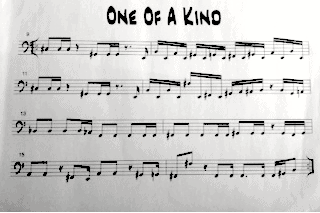
Transcriptions of Jeff Berlin’s Forever Until Sunday and One of a Kind


Jeff Berlin is the living proof that the electric bass can be a viable jazz instrument. His melodic phrasing and soloing is hornlike and his walking bass is as propulsive as any upright bassist’s. Many bassists think like bassists when they solo; Berlin thinks music and plays flowing legato lines and builds solos that excite and build through their own musical logic. He is able to speak the language of his influences: Sonny Rollins, Keith Jarrett as well as John Coltrane.
Jeff Berlin’s bass playing is somewhat similar to that of Jaco Pastorious though Berlin usually plays a fretted bass. Jeff is also well known as a particularly outspoken supporter of music education. He was a founding member of the Bass Institute of Technology in Los Angeles and later founded the Players School of Music in Clearwater, Florida.
Jeff Berlin is still one of my major influences therefore this month I am transcribing “Forever until Sunday” as well as “One of a kind” which are two tracks that can be found one the album titled “one of a kind” by Bruford. Bruford were a band that former “Yes” and “King Crimson” drummer Bill Bruford formed and led in the late 1970s.

The transcriptions are my favorite excerpts of the bass groove.
For more information you can check
www.jeffberlinmusic.com
www.cdbaby.com/cd/JeffBerlin1

Tuesday, January 18, 2011

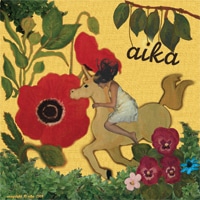
aika : CD review

“Aika… The purpose of Music is to give us a completely different idea of the things we know best.”
A single piano with the backing of strings gives way to one of the most electrifying voices of the current Californian as well as Japanese music scene, singing words of pain, self-knowledge as well as strength. The words work their way to a climax accented by thriving harmonic progressions as well as strong rhythm section, which gently fades away again, leaving the listener in stunned silence from the beauty of the moment, as well as the memories that will be awaken. This is “You told me you loved me”, the first track of aika’s (Aika Hirahara) self titled limited edition single.
“You told me you loved me” originated out of aika’s desire to record a song about relationships. She asked collaborator Nicolas Farmakalidis (NeilaProductions) to help out and the outcome is a tribute to the pair’s symbiotic teamwork. The final touch, was made by Grammy award winning mix engineer Dave Reitzas who gave the song depth that shares similar distinctiveness as the famous “I will always love you” by Whitney Houston, which is also mixed by him.
“You told me you loved me” is the type of big production that does not always fit easily into the typical pop radio play list, however the song is already taking off some airplay in most of the local radio stations and college radios around the country as well as various public and commercial Japanese radio stations. It is a song that is very likely to generate significant listener requests. Don’t be surprised if “You told me you loved me” is near the type of the pop singles chart by the early spring of 2011!
Aika is telling us a story about personal struggles in the second track of the single titled “Sinking – Caress Me”. Here, producer Nicolas Farmakalidis created an admirable stab of a unique retro 40′s circus atmosphere. Despite the fun and engaging feeling that this exceptional track creates, the background vocals and the brilliant use of strings produce certain unhappiness and a feeling of desolation. The producers explained that this song is trying to describe social isolation in the modern society. Nicolas specifically said that “Every true artist- whether it be Mozart, Bob Dylan or El Greco- it doesn’t matter what they do or how they do it. Important is that they understand the human condition better than anyone else. ”
Aika described this work with an Oscar Wilde quote “Some people come into our lives and quickly go. Some stay for a while and leave footprints on our hearts – and we are never, ever the same.”
For more information about aika and her upcoming tour dates, as well as the album release be sure to check them at:

Tuesday, January 4, 2011

Importance of Details

I always find myself engaging in conversations about the importance of “details” in music as a whole. If you check the dictionary, details are particulars considered individually and in relation to a whole. In other words, without the details, it is difficult to understand and see the big picture. These small, elaborated elements make the difference.
The last few years I have been trying to get deeper and deeper in the session scene. I had the privilege of working with many amazing music producers. The more I converse and discuss with music producers, the more I admire their skills, perhaps the same way we admire the skills of top bass players. Bassists like Jaco Pastorius, Marcus Miller, Ray Brown or even some more contemporary bass players like Damian Erskine or Hadrien Feraud are simply remarkable. Their time, feel, sound and most important their “voice” are second to none.
The “best” music producers – or should I say the music producers who pay attention and know how to treat the subtle “details” of a musical composition – are extraordinary individuals as well as musicians. In addition to their amazing musical abilities, they can understand, oversee and know how to use small subtle elements, in order to make their music unique and exceptional.
Top music producers got their skills from working on details. They practiced small things again and again, repeating their lesson with – as well as within- every music principle. By using the information they learned in a normal study room, their skills became second nature. These producers make it look so easy, to compose, re-harm, arrange, program, record etc, when in fact they stumbled through their process for a long time until they became comfortable with all these information they mastered.
If you check top-notch producers such as Rick Rubin, Nicolas Farmakalidis, Peter Gabriel, you will understand what I mean.
A few days ago, I had a great as well as very educational recording at Neilaproductions, for an up and coming singer – songwriter style album. It was probably the most instructive experience of my life. Before the recording, the producer explained the particulars of the recording. The clearer the facts of the recording, the better the result will be and the sooner we will finish.
The producer creatively guided and directed the process of making the record, like a director would a movie. The music producer’s job is to create, shape, and mold a piece of music. What I really found amazing was that during the recording, the producer changed my bass line as well as the strings voicings, doing re-harmonization and arranging on the spot. I did study the “science” of re-harmonization as well, however to be able to do it during a recording session and be absolutely correct without having an instrument next to you, is simply astounding.
If music is played as an art, I personally believe that it is best to be learned as a science though. It can be as specific as chemistry. For instance, if you take a minor third and add a perfect fifth from the root, the result will be a minor triad. Consequently, in chemistry, if you take two atoms of hydrogen and add one atom of oxygen you form one water molecule. The important is to understand the difference. Music is an art that has always offered the best results to students who learn it as a science. However, after you gain knowledge of these certain methodologies, you perform those with passion and a desire to create and touch people’s hearts. My point is that, my friends in Neilaproductions must have been studying arranging and re-harmonization as a science and now they are skillful and knowledgeable enough to be able to use that knowledge in order to create and enhance the beauty of a piece of music.
My last point, which I understand the more I study and record, is the concept of “time”. The performed rhythm – for instance a bass line – can sound very straight, exactly on the beat, swinging laid back or rushed. Important is how a listener perceives the timing of these rhythms and recognizes it as being ‘rushed’ or ‘swinging’, as well as why a rhythm with a slightly shorter note not is simply a different rhythm. These are matters that we do not typically address in music theory. However, they are essential aspects during a recording session as well as they are fundamental in the development of a cognitive theory of music as performed and listened to. Research in the perception of music as well structuring of events in music, is quite different from the concept of time in physics. “Listeners to music do not perceive rhythm on a continuous scale. Instead, rhythmic categories are recognized which function as a reference relative to which the deviations in timing can be appreciated”. (Nicolas Farmakalidis)
In fact, temporal patterns in music combine two time scales that are essentially different: the discrete rhythmic durations as symbolized by, for example, the half and quarter notes in a musical score, and the continuous timing variations that characterize an expressive musical performance – what musicians referred to as “feel”. By being in the studio with talented musicians and producers you understand how important time is and how it varies from every style of music to another.

To sum up, pay attention to details. This is what makes the difference. Every major artist and every truly dedicated student in every art form knows this.
Monday, December 6, 2010

Maxwell's Urban Hang Suite : Transcription and analysis

“Maxwell’s Urban Hang Suite” is the debut album of American R’n'b and neo soul musician Maxwell that was released in 1996. By listening to this album I was completely blown away by the albums impressive, atmospheric and “silky” sounds, the funky instrumentation, which was decorated with a horn section, wah-wah guitar, Rhodes, piano and of course lastly the Deep, Eloquent and Lucid bass lines!
Along with D’Angelos “Brown Sugar”, and Erykah Badu’s Baduizm “Maxwell’s Urban Hang Suite” has been recognized by music writers for providing commercial visibility to neo soul. It has been cited by critics as Maxwell’s greatest work and remains as his best-selling release with domestic sales of over two million copies.
The tracks “Ascension”, “Dancewitme” as well as “Welcome” really influenced my bass playing. I hope that these bass lines will inspire and motivate you in the same way that they inspired me.
The following transcriptions are the basic grooves of Ascension, Dancewitme and Welcome.


Enjoy

Tuesday, November 16, 2010

I know you know - Esperanza Spalding - Transcription

I know you know is the second track on Esperanza Spalding’s self- titled project. In general this album combines elements of Latin flavored jazz compositions, startling mixture of alluring acoustic bass as well as various jazz sounds and mechanisms, which only are a proof of her talent. On this specific track, the bass establishes a push-and-pause funk syncopation, while her vocal is a spray of eighth and 16th notes. It carries a Neo-Soul undertone, with a touch of Caribbean hooks. Her lyrics about youthful flirtation may be generic and repetitive, but their abundance of “b” and “no” sounds is perfect for her dizzying swoops and soars through the melody.


Saturday, October 30, 2010

Herbie Hancock Spank a lee - Bass Transcription

We are well into the 21st century and “Thrust”, by Headhunters, still impresses the new generations of musicians. This Jazz fusion album was released in 1974 by Columbia records. On this album, we can perceive influences of jazz, rock,funk, soul as well as African Rhythms. Hopefully, after a few years we can see the same innovation, modernism and creativity taking place in this century!
“Spank-A-Lee”: I can only describe this track with only one word. Groove. Mike Clark and Paul Jackson create a steady polymetric funk beat. This beat, is supported by Herbie Hancocks’ funky keyboard comping, as well as, simple, straightforward melodic lines.
Paul Jackson’s Jaco Pastorius-like bass playing and the cooperation with Mike Clark and Herbie Hancock create an inspiring solo base for Bennie Maupin’s tenor saxophone. The rhythm, improvisation and feeling inspire many young musicians nowadays and hopefully will do the same in the future.
The transcription is the main groove of the track. Enjoy!